ABSTRACT : In this research, the dynamics and control of web handling in roll-to-roll (R2R) systemsusing a driven roller are presented. The viscoelasticity effect for systems with and without the driven rolleris analyzed to study web dynamics. To achieve high precision control performance, the driven roller isresponsible for regulating web speed, while the winders regulate tension control. A tension feedback controlis used as a cascade control to achieve a fast system response, and feedforward compensators are provided toaccount for changes in the winders’ radius. Control performances are verified under several scenarios usingan experimental setup. The web tension is validated with errors of ±0.625%, ±1%, and ±1.25%, while theweb speed is validated with errors of ±0.0007 m/s, ±0.002 m/s, and ±0.0008 m/s at speed levels of 0.01m/s, 0.05 m/s, and 0.1 m/s, respectively. Furthermore, it is verified that the tension error in the desired lineartension profile change is around ±0.25 N at 0.01 m/s.
INDEX TERMS Cascade control, Driven roller, Roll-to-Roll, Web dynamics, Viscoelasticity effect.
I. INTRODUCTION
The Roll-to-Roll (R2R) system has been developed as an innovative and eco-friendly manufacturing technology capable of large-scale mass production, low cost, and rapid manufacturing process, among other features [1]–[3]. Therefore, this continuous manufacturing system is widely used for producing flexible and printed electronic devices (Internet of Things (IoT) devices, Light Emitting Diode (LED) displays, Organic Light Emitting Diode (OLED) displays, and thin film cells), as well as electrochemical devices (batteries, capacitors, and fuel cells) [4]–[16]. To manufacture these types of products, web handling is an essential process since high-quality products can be produced through this process without any damage or defects. Therefore, high-precision performance is required in the operation of the R2R system. The fundamental concept of web handling is the process of moving the web appropriately using the rollers in the R2R system. The web, which is wrapped on the unwinder, moves through several rollers and finally wraps on the rewinder during web transportation. Therefore, major components are needed for transporting the web, such as unwinder, rewinder, idle roller, driven roller, etc. The unwinder and rewinder are used to unwind and rewind the raw material so that these are the core parts in the R2R system.
The idle roller can freelyspin at one degree of freedom and uniformly transfer the web to the other roller so that it can support/move the web during web processing. The driven roller is used to regulate the speed of the web so that the web speed is consistently maintained at the desired setting value. Moreover, the tension zone can be separately divided using the driven roller.Recent research has introduced only two actuators-based R2R system to handle the web during web transportation along the moving direction [17]. The rewinder is responsible for regulating the web speed based on the estimated radius, while the unwinder regulates the tension simultaneously, allowing for control of web speed and tension using only two winders. However, the accumulation of estimation errors in radius leads to an increase in web speed error, and the tension regulation becomes limited in a long-span R2R system. Therefore, including a driven roller is necessary to minimize the web speed difference and achieve higher tension tracking control in the long span of the R2R system.The research presents the dynamics and control of the web in the moving direction of the R2R system with the driven roller. For the system structure, the driven roller is used to regulate the web speed, and each winder module (rewinder and unwinder) is used to regulate the web tension for each tension zone.

Therefore, the proper installation of load cells at each tension zone is a critical part of our system. Including two idle rollers in the processing zone, at least three idle rollers for each winder module are needed to properly install the load cells so that the tension measurement can provide feedback for the control loop. The force direction from the load cell is the same as the gravitational acceleration direction, so the web wrap angle should be maintained at 90 degrees using other idle rollers. The diameter of the idle roller should be smaller than that of the shaft in the winder. Since our system is used to verify the control performance, including the driven roller, the web span length is shorter than that in the Roll-to-Roll system used for massive production. Furthermore, a dynamic model of the web is presented, including the viscoelasticity effect, to analyze the accurate web dynamics, allowing validation of the frequency response of the model compared to that of the web in the actual system. To achieve accurate tension and web speed control performance, the driven roller utilizes speed control, and winders (rewinder and unwinder) utilize tension control, respectively. Cascade control is utilized to design the tension feedback control and achieve a fast system response. The inner loop is utilized as the velocity control loop, and the outer loop is utilized as the tension control loop. The experimental validations of several scenarios with the hardware setup are presented to achieve high-precision control tracking in the R2R system.This paper is structured as follows. In Section II, the system architecture with major components of the R2R system is described. In Section III, the mathematical models of the web dynamics and roller dynamics are described. In Section IV, the control designs including the control structure and its algorithms are described. In Section V and Section VI, the hardware setup and the experimental verification of the control performances are described. In Section VII, the conclusion and future recommendations are described .
II. SYSTEM ARCHITECTURE
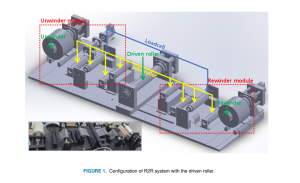
In the presented system, several components are utilized to handle the web under controlled performance along the moving direction. These components include an unwinder, rewinder, driven roller, 8-idle rollers, and 2-load cells. The winding parts have a mechanical shaft that can lock the aluminum core with a steel-based lug to reduce slip between the shaft and the core. The film used is PET, with a thickness of 0.18 mm and a width of 150 mm. The full film radius and aluminum core radius are about 71 mm and 48 mm, respectively, while the driven roller has a radius of about 37.25 mm. The idle roller, which has a radius of 30 mm and a width of 196 mm, supports and transports the web along the moving direction. To select the motor for the winders and the driven roller, a direct-driven rotary (DDR) motor is utilized, eliminating the need for a mechanical coupling required for a conventional servo motor. Load cells are used to measure the tension for providing feedback control, allowing each winder module to regulate the web tension. The R2R system is symmetric based on the driven roller, making it convenient to handle the web along the moving direction for tension control. The detailed configuration of the R2R system with the driven roller is shown in Fig. 1.